
Where is the White Space for Canadian Defence Founders?

Alex McIsaac here from Northside Ventures. At the beginning of the year I published my 2026 predictions and put “Canada’s defence and security sectors boom” near the top. A recent study from BDC and The Icebreaker highlights the growing opportunity, and the challenges, for Canadian SMEs building in the Canadian defence ecosystem. But now we wanted to answer a slightly different question: where is the white space for founders looking to start a company in the defence and dual-use industry today?
Northside Venture’s Dual Use Portfolio
At Northside Ventures, we invest in exceptional Canadian founders at the point of inception and ideation. Over the past four years we’ve made 34 investments, 12 of them, or 35%, are dual-use companies aligned with Canada’s Defence Industrial Strategy (DIS) ten sovereign capabilities, which are:
- Aerospace — platforms, avionics, aircraft communications
- Ammunition — common ammunition, battle-decisive munitions, small arms, missiles and bombs
- Digital Systems — secure cloud, AI, quantum computing, integrated C3, high-assurance comms
- In-Service Support — naval, land, air maintenance and sustainment
- Personnel Protection — medical countermeasures
- Sensors — marine sensors, quantum sensors, electronic warfare
- Space — ISR, space domain awareness, satellite comms, launch
- Specialized Manufacturing — land vehicles, surface ships including icebreakers
- Training and Simulation — naval, land, air
- Uncrewed and Autonomous Systems — land, aerial, underwater, surface (including collaborative platforms)
Including both direct and indirect applications our portfolio spans several of these categories including ammunition, space, specialized manufacturing, autonomy, and digital systems:
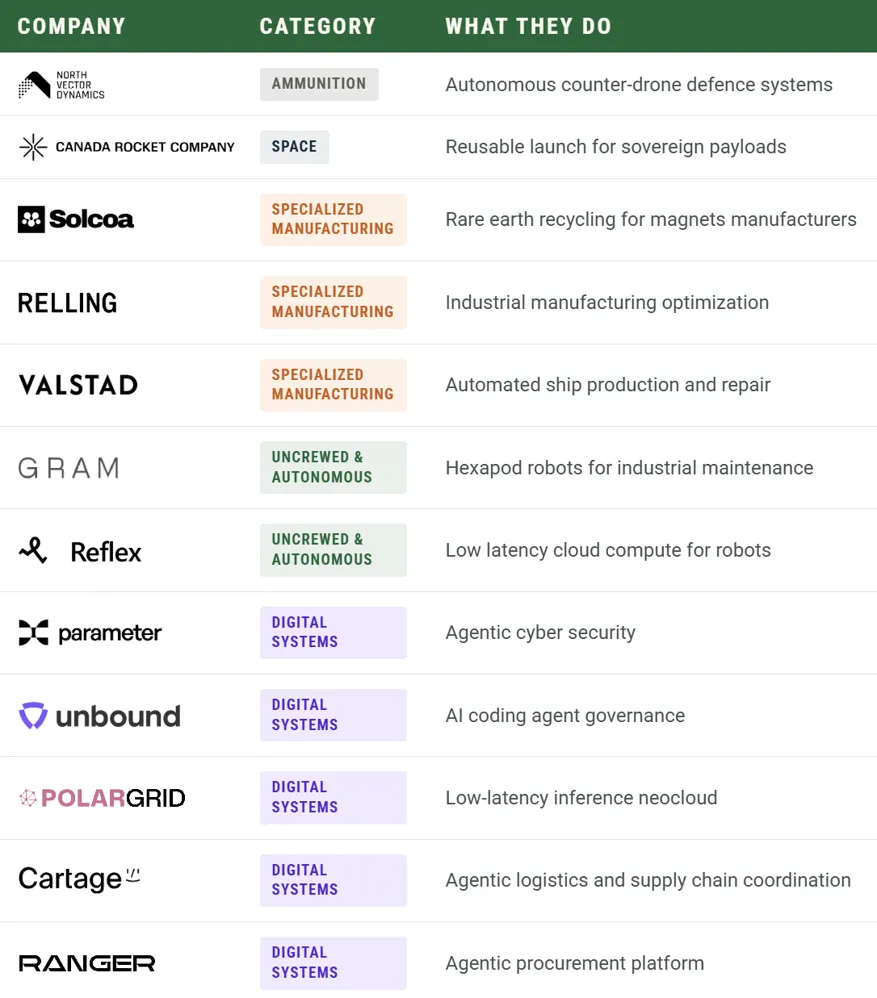
We have yet to make investments in categories including aerospace, in-service support, personnel protection, sensors, and simulation, but are actively looking at these areas for new investments.
Defence Market Tailwinds & Opportunity
The tailwinds in defence have never been so strong. Global military spending rose 41% between 2016 and 2025 and Canada has pledged to increase defence spending from 1.5% of GDP in 2024 to NATO’s new 5% of GDP target by 2035, comprising 3.5% for core defence and 1.5% for defence related investment. The core slice alone more than doubles annual defence spending this decade to roughly $159B and lifts Canada from the world’s 16th-largest spender toward the top 10.
Ryan Gariepy, co-founder of Clearpath Robotics and chair of the Canadian Robotics Council, made a similar point in a recent Q&A, noting that as Canada expands its military “we will need force multipliers” — and that the country’s vast, sparsely populated, and harsh terrain makes it a natural fit for robotics and autonomous systems.
In many ways this is more capital than a neglected Canadian defence industry can absorb all at once. There will be more dollars chasing Canadian dual-use companies than there are quality opportunities to invest in. Like any gold rush of the past some of these bets won’t pay off. That said, there will be opportunities to invest in great founders building great companies and the fact remains that founders today have a better chance of succeeding at building a defence company than at any point in recent memory. We are already seeing experienced operators who built SaaS companies choose defence because they recognize the market. Take Hugh Kolias for example, a repeat Canadian founder who previously sold a SaaS company is now building Canada Rocket Company, to create sovereign launch capability and access to low earth orbit that does not have to rely on other nations. Industry outsiders have always built great companies. Horizontal skills like fundraising, hiring, and leadership are transferable and in many cases a fresh perspective can be an advantage.
The Broader Canadian Dual-Use Landscape
The BDC-Icebreaker report surveyed 642 companies operating in or adjacent to the defence industry and arguably is the largest strongest dataset of dual-use companies ever collected in Canada. One observation we made is that many of the companies surveyed are not what we would call ‘venture-backable’ and many are certainly not early stage ventures. Of the 642 SMEs surveyed, 73% are “defence-light,” with most revenue coming from ‘civilian work’, and are funded by working capital and credit rather than equity. Additionally, many of the companies are already scaled (29% have 100+ employees) with capabilities in construction, engineering services, ground vehicles, and shipbuilding.
As early stage investors we logically asked the question, if there are 640 dual-use companies in Canada today, how many existing dual-use companies are venture-investable early stage companies?
The Early Stage Canadian Dual-Landscape
The company list of survey respondents was not made public so we built our own list of dual-use companies founded in the last 5 years and identified 84 companies. Of these, only 28 were founded in the last two years.
At Northside we typically invest in pre-seed companies which we define as being less than two years old. So given our criteria there are only 28 opportunities for us to look at before we’ve exhausted the entire market of existing companies. When we expand our definition of pre-seed to 5 years old we’re still only at 84 companies. For context, at Northside we screen approximately 5,000 companies a year, meet with 500, and invest in 12 companies each year.
The next logical question is, if there are so few dual-use companies existing today then what about the companies of tomorrow? Where is the white space for new founders looking to build in the defence industry?
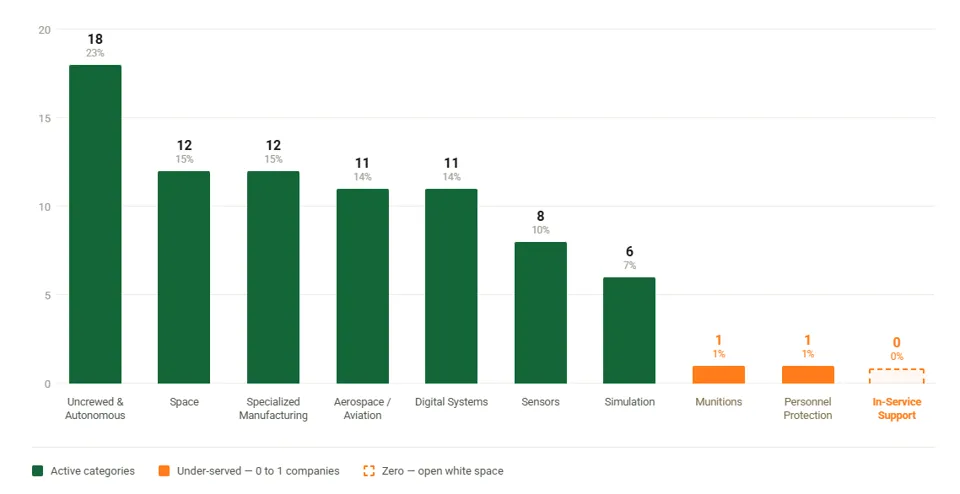
We mapped the 84 startups against DIS’s ten priority capability areas and shows formation is heavily concentrated at the top. Uncrewed and autonomous systems lead with 18 companies, followed by space (12), specialized manufacturing (12), aerospace (11), digital systems (11), sensors (8), simulation (6) and only 1 company in munitions and 1 company in personnel protection. Notably, Northside is invested in the sole Canadian munitions company founded in the last 5 years. We found zero companies providing in-service support that were founded in the last 5 years.
The White Space for Canadian Defence Founders
This isn’t about Canada lacking companies in these categories, it’s that less than 100 founding teams have started new ones in the last five years. While much of Canada’s growing defence budget will flow to established contractors, a material share is being directed toward early-stage company investment. Many of those companies will be at the leading edge of AI, autonomy, and advanced technology.
Some might argue not all ten categories fit the traditional venture model equally — that categories like specialized manufacturing or munitions are too capital-intensive or too service-based for a typical pre-seed check — however, we’re living in an exciting time in venture where traditionally non-backable industries are becoming backable. Software, AI agents, hardtech, and robotics are unlocking categories once written off, from advanced manufacturing to materials science, and the landscape of what’s fundable at the earliest stage is being reshaped in real time. We think all ten categories belong in that conversation.
To help founders understand where the opportunity lies, here’s our take across each of the ten DIS categories:
Uncrewed and Autonomous Systems (18 Canadian startups) is a category with global venture-backed leaders like Saronic, Chaos Industries, Ghost Robotics, Firestorm, Shield AI, and Helsing with no dominant Canadian incumbent at the platform level. Globally, the category is crowding quickly and undifferentiated drone and autonomy platforms is a harder concept to sell to investors today. We see a market opportunity, not in more generic platforms, but in more specific categories of autonomous systems unique to Canada such as specialized arctic and subsea autonomous systems. Canada borders three oceans and access to talent and testing environments that could make it a world leader in these areas.
Space (12 Canadian startups) as a category is led globally by SpaceX, Blue Origin, and Rocket Lab with MDA, Kepler Communications, Canada Rocket Company, Reaction Dynamics and NordSpace anchoring Canada. The government has earmarked $180M for sovereign launch capability and Canada has genuine strategic interest given its Arctic geography. Beyond launch, there is also opportunity in space control and space domain awareness, with companies like NorthStar Earth & Space focused on tracking and monitoring objects in orbit. Space-based communications is another strategically important area, where Telesat plays a critical role for defence and sovereign connectivity. Think a software layer that connects data across commercial and government satellites, giving defence teams a real-time view of the space environment and improving threat detection, coordination, and communications.
Specialized Manufacturing (12 Canadian startups) as defined by the DIS which focuses on shipbuilding and land-vehicles, is dominated globally by companies like General Dynamics, BAE Systems, and Fincantieri, with Roshel and Irving Shipbuilding holding the major Canadian programmes. A new venture-backed company is unlikely to win the shipbuilding contracts themselves, however, the primes depend on specialized subcontractors and support services they can’t build themselves, and Canada’s commitment to domestic shipbuilding, submarines and Arctic vessel production creates a long, predictable demand signal that flows down through that supply chain. We think there is an opportunity for specialized subcontractors that own a critical capability the primes need but don’t build such as precision components, advanced coatings, rare earth element processing and certification services purpose-built for defence-grade marine and land vehicle production.
Aerospace (11 Canadian startups) is anchored by global leaders like Lockheed Martin and Boeing and a deep domestic industrial base led by Bombardier, Magellan, and Pratt & Whitney Canada. The F-35 program has pulled Canadian firms deeper into allied supply chains. For a new founder looking for new ideas, we think there’s an opportunity to build the intelligence layer on top of commercially available hardware — think a mission intelligence platform combining synthetic environments and post-mission analytics to help governments train, rehearse, and optimize the fleets they already operate — without requiring hardware changes.
Digital Systems (11 Canadian startups) is led globally by Palantir, Anduril, and Microsoft Defence, with Canada’s emerging leaders including companies like Cohere and Xanadu in the AI and quantum categories. Digital systems is likely the most ‘VC-friendly’ category as the bulk of venture investors have invested here for decades. The greatest risk for founders entering this category today is underdifferentiation. We think the greatest digital systems companies will be differentiated in one of three ways: a) the founder has a distribution advantage, b) the company has access to proprietary data or c) the problem is technically challenging and hard to replicate. For example a secure data platform that makes classified and unclassified intelligence streams interoperable across Five Eyes and NATO partners in real time — the missing middleware of allied digital defence.
Sensors (8 Canadian startups) is dominated globally by Thales, Hensoldt, and L3Harris, with no major Canadian incumbent at the sensor level outside of research institutions. Dominion Dynamics is a notable new entrant as a neo-prime, but focuses more on sensor integration leaving room for a domestic hardware leader. Canada has a competitive advantage in quantum sensing with government and university programs that are world-class. While traditional radar and Electro-Optical/Infrared sensing is generally covered, quantum-enabled sensing for GPS-denied environments is not. For example there is likely an opportunity for quantum-native positioning and navigation system used on submarines and Arctic vessels operating where GPS doesn’t reach.
Training and Simulation (6 Canadian startups) is led globally by CAE, Cubic Defense, and Bohemia Interactive Simulations. Notably CAE is based in Montreal and a category anchor, boasting a ~$10B market cap and decades of operating history. While CAE owns the high-end hardware simulator market, what it has not built is the software-first layer above the hardware, which could include adaptive scenario generation, AI-driven performance assessment, and synthetic training environments that don’t require a physical simulator at all. Think an AI-native training platform that generates adaptive, high-fidelity combat scenarios on demand, bringing the scalability of software to military readiness without the $50M simulator.
Ammunition and Munitions (1 Canadian startup) is dominated globally by Raytheon, Rheinmetall, Nammo, and General Dynamics, with Calgary-based Northside portfolio company North Vector Dynamics being the lone-Canadian company in Canada. The DIS has named this a sovereign priority and the CDIR program is explicitly investing in domestic production capacity. This is likely a manufacturing and materials challenge more than a software one and there is an opportunity to bring modern process engineering and novel propellant chemistry to a sector that has seen little innovation. Think a next-generation propellant and munitions manufacturer built around advanced materials science and precision manufacturing — the kind of deep industrial capability Canada has committed to building domestically and currently has to import.
Personnel Protection (1 company) covers medical countermeasures and soldier protective equipment, a $27B global market growing to $56B by 2032. Led globally by Point Blank and DuPont, with no dominant Canadian incumbent. The innovation frontier has moved beyond ballistic protection into integrated systems like armor that monitors soldier health, detects blast exposure, and communicates physiological data back to command. Canada’s life sciences and materials research base gives founders genuine technical starting points and the DIS explicitly names this a sovereign capability. Think of a smart soldier protection system like next-generation body armor embedded with biosensors and real-time health monitoring that tells commanders who is injured or at risk before they report in.
In-Service Support (0 companies) is led globally by Babcock International and Amentum, with Canadian leaders IMP Aerospace & Defence, Cascade Aerospace, and Field Aerospace. Despite a $2.7B domestic market and 500+ vendors, no venture-backed entrants have emerged in the past five years. The global military MRO market exceeds $90B. The DIS has named in-service support a sovereign capability, fleet readiness targets are explicit government commitments, and Canada’s aging military assets create sustained non-discretionary demand. The incumbents have had little emerging competitive pressure to modernize and run on relationships, paper-based processes, and legacy software. Think a predictive maintenance platform for the Canadian Armed Forces fleet that tells operators what will fail, when, and at what cost before it grounds the aircraft or ship, built for a market where no one has tried.
Final Thoughts
Canada is at an inflection point with tremendous government capital commitments and a policy framework in place but what’s currently missing is new company formation across categories the government has defined as priorities for sovereign capability. Across ten sovereign capability areas the early-stage landscape remains thin and in several categories non-existent. The problem is an opportunity for any new founder looking for their next idea. The next generation of great Canadian defence companies will be built by founders who move now before the white space fills in. If that’s you, we want to be your first call — if you’re working on any ideas we’ve covered we’d love to connect.
This post and the underlying analysis was based on access to public and private data but without a doubt have missed some information.
Latest updates
Explore more news and insights from the Northside community.



Building something wildly ambitious?
Or maybe just thinking about it? We want to meet you.
